
How to find the best women’s cycling clothing: Fit and buying guide

Cycling gear that performs as you need it to, keeps you comfortable and makes you feel confident can be a game changer when it comes to enjoying your time on the bike. But when there’s so much choice out there, all with a range of price tags, it can be tricky to know what to look for to get the best women’s cycling clothing. In our buying guide, we’ll talk you through why here at VeloVixen we believe a women’s-specific fit is essential, the key items to add to your cycling wardrobe. And the features to look out for while you’re shopping for women’s cycling gear to make sure your new cycling outfit is going to help you feel great on the bike!
Why does a women’s specific fit actually matter for cycling clothing?
Unisex cycling kit is more often than not, just men’s cycling kit with a ‘sure, women could ride in this too’ label. And let’s be clear: if unisex or men’s kit is comfortable for you, that’s awesome! We don’t believe in ‘rules’ here at VeloVixen so first and foremost, wear whatever makes you feel good. That being said, women tend to have a different build to men. And so when it comes to cycling kit, our needs are also different. In general, women tend to have a shorter torso length, a wider pelvis and narrower shoulders. That means we need our padding distributed differently in our bib shorts to accommodate female anatomy (read more in our guide to avoiding saddle sores) And we need our cycling jerseys tailored to match our proportions.
If you’ve ever worn a jersey cut for a male frame, chances are you’ve found it doesn’t sit right. The shoulders bunch, the hem rides up. There’s excess fabric here – and overly tight sections there. A women’s specific cycling jersey will fit just so. Staying put, feeling comfortable and ensuring you can focus on the ride rather than annoying kit issues.
When it comes to cycling bib shorts, it’s even more important to go for a women’s specific pair. That’ll ensure the bib straps can accommodate your chest, the waist sits well and the cut is designed to fit your hips comfortably. But crucially, it’ll also mean that you’ve got a female-specific chamois pad sewn in. This will help to reduce chafing, hotspots and the risk of developing painful saddle sores. We’ll dive deeper into what to look for in a good pair of women’s cycling bib shorts below!
At VeloVixen, we work with the best women’s cycling apparel brands to bring you tried and tested cycling gear made specifically for women – not scaled down versions of men’s patterns.
Women’s cycling jerseys: function, fit and what to look for
Let’s start with women’s cycling jerseys. A game changer for comfort and convenience, and one of the best ways to express your individual style on the bike. Keep reading to find out why we reckon a cycling jersey is an essential bit of kit, the difference between the different types of jerseys on offer – plus key features to look for and how your cycling jersey should fit.
Why do I need a cycling jersey?
First and foremost, a cycling jersey is all about comfort while you’re riding. Whether you opt for a road jersey or a mountain bike jersey (more on the differences in a moment!) you’ll generally find that they’re constructed from technical fabrics which are lightweight, breathable and quick drying. That means when the weather is warm, or you’re working up a sweat while you’re making your way up a hill, you’re not going to get that horrible t-shirt sticking to your back feeling that you’d get wearing a regular, cotton top. And, if the breeze picks up or you’ve got a long descent to cruise down – you’re not going to have a soggy, sweaty t-shirt making you chilly. Put simply, cycling-specific kit is designed to keep you at the optimal temperature while you ride.
Not only that, cycling tops are also cut to be comfortable to wear when you’re in the riding position. Your posture when you’re on the bike versus off the bike is going to be pretty different. By choosing a women’s cycling jersey you won’t have sleeves which get really tight around your shoulders while you’re reaching for the handle bars, or annoying fabric bunching up around your waist while you ride.
Road cycling jersey vs mountain bike jersey: what’s the difference?
Choosing between a road cycling jersey and a mountain biking jersey comes down to a combination of preference, and your cycling goals. To help you choose, here are the key differences:
Road cycling jersey features
- Designed to fit closely to your body to offer better aerodynamics.
- No excess fabric flapping in the wind to create drag and slow you down, means you’ll be able to ride faster for less effort.
- Usually constructed with stretchy, performance fabrics for a fit that’s close yet comfortable and moves with you.
- Typically have at least three pockets on the back to carry essentials, so you don’t need to wear a backpack.
Recommended products


Mountain bike jersey features
- Casual, looser fit.
- Less performance focused. Designed for off-road rides where it’s all about exploring and taking on technical trails, versus trying to ride super fast.
- Usually more of a technical t-shirt, without pockets (because a lot of mountain bikers where cargo-style shorts with pockets instead).
All that being said, there’s no real rule that says you can’t wear a mountain bike jersey while you’re riding on a road bike! If your focus is just enjoying the ride, so speed/performance isn’t as much of a priority, and you feel more comfortable in a looser fitting jersey – there’s nothing stopping you from choosing a mountain bike jersey for your road cycling adventures.
What should I look for in a women’s cycling jersey?
When you’re shopping for a women’s cycling jersey, it’s important to make sure the jersey you pick comes loaded with a few essential features:
- Breathable, sweat-wicking fabric. Think lightweight materials, mesh panelling and fabric designed to wick sweat away and dry quickly to keep you comfortable.
- Multi-way stretch. A great cycling jersey will have four-way stretch so that it fits closely, moves with you and never feels restrictive.
- Women’s specific tailoring.
- Elasticated waist. Ideally with additional silicone grippers, this will help to keep your jersey in place even when you’re getting out of the saddle.
- Good quality zip such as YKK. Trust us, you won’t want to risk a zip that doesn’t work properly and gets stuck when you’re desperate for the loo and frantically trying to remove layers so you can pull your bib shorts down! We like zips with a stop and lock mechanism so you can also partially unzip on hot rides, without the zip fully… unzipping. Bonus points for a zip guard at the neck too – stops any scratching or chafing.
- Well-placed pockets. It should be easy to reach behind your back and access anything in your pockets on the move.
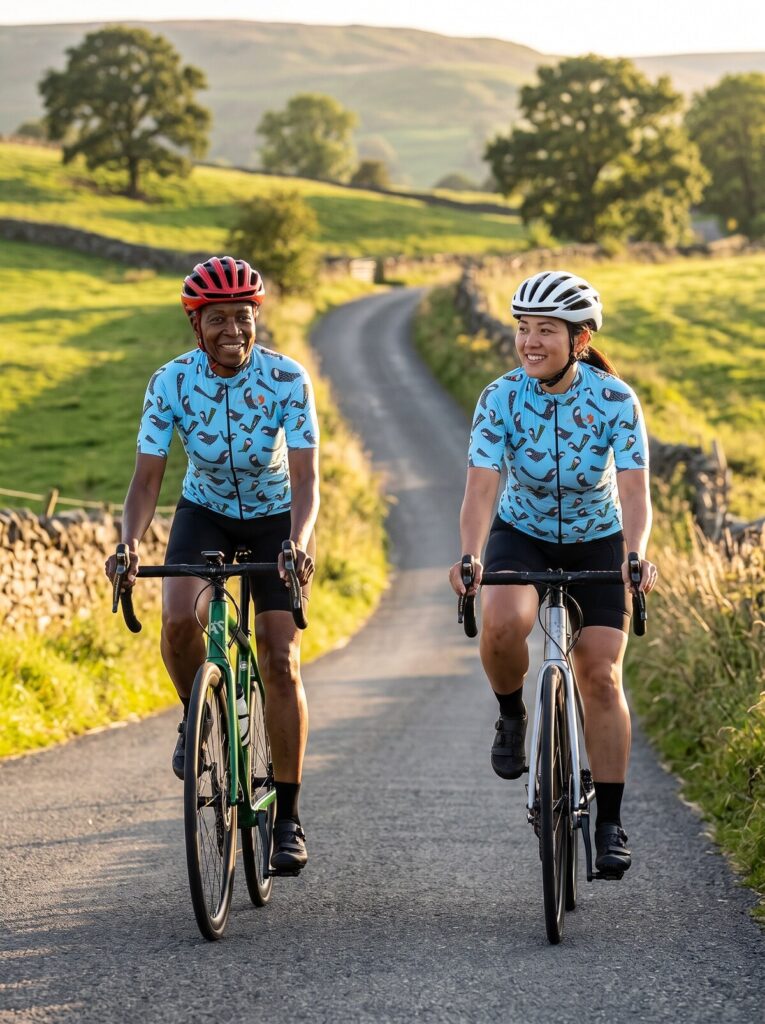
- Beautiful designs! Finally, you want a cycling jersey that expresses your style and puts a smile on your face. That’s why here at VeloVixen we work with some incredible designers (including some awesome female designers on some of our latest collaborations) to make sure our collection of women’s cycling gear will have you standing out from the crowd.
How should my cycling jersey fit?
Getting the right fit for a women’s cycling jersey starts with understanding that it’s all about how it feels when you’re on the bike, rather than purely basing it on how it feels standing in the changing room. Cycling jerseys are cut to allow you to lean forward over the handlebars, so when you’re standing upright the hem at the back will sit lower than at the front. It can take a bit of getting used to, but this asymmetry is by design. If it’s a road cycling jersey, it should sit close to your body but it shouldn’t be so tight that the zip is pulling or warping and you shouldn’t feel restricted.
Women’s jerseys are designed for narrower shoulders, so you want the fabric to sit comfortably across your shoulders without bunching up (or conversely, feeling restrictive). Check that you can reach forward for the handle bars comfortably. Make sure there’s no excess fabric under the armpit either, as this can bunch and cause friction. We love a laser cut sleeve here at VeloVixen, because it means the arm opening sits closely around your bicep without digging in. If the jersey feels like it’s squeezing your bicep too much, you might want to size up.
When you’re trying on your new cycling jersey, have a go at reaching your pockets as if you were on the bike. In a riding position, your pockets need to be reachable without having to twist too much or perform Houdini-like arm contortions. A men’s-cut jersey puts those pockets too high and/or at the wrong angle for female riders. Women’s cuts position them where they’re actually useful!
How to stop cycling from hurting your bum: Cycling bib shorts and padded cycling pants
There’s nothing quite like sore hindquarters to ruin a bike ride. One of the first things that most of us learned when we started cycling was the importance of good cycling shorts! You might feel a bit like a toddler in a nappy at first, but wearing shorts or underpants with a sewn-in pad (known as a chamois pad) will provide you with protection and support from all the bumps out on the road or the trails. For female riders, it’s important to look for cycling shorts/underpants which have a women’s-specific chamois pad. Our anatomy is different to our male riding buddies, and that means we need padding which is tailored to give us support where we need it – without a load of excess fabric which can then cause chafing and saddle sores.
Here at VeloVixen, we have a few different options to help you keep your undercarriage happy when you’re out on the bike:
Padded shorts vs padded underpants
Padded cycling shorts are your ‘all-in-one’ option. Like a road cycling jersey, padded cycling shorts tend to be close fitting and are made from high stretch fabric so that the padded section can sit right where it needs to and you haven’t got excess material flapping about in the breeze.
If you prefer to wear a looser fitting short, or if you want something that you can wear under your regular clothes for the shorter commutes or the quick pootles down to the pub – our much-loved padded cycling knickers are a great option! Offering a more discreet option, they’ll have you riding like a pro… but keeping it on the down low.
Recommended products
-

IRIS All Over Women’s Bib Shorts Purple
Original price was: £185.00.£90.00Current price is: £90.00. -

VeloVixen Padded Cycling Knickers – Dandelioness
£42.00 -

Stolen Goat Black Endurance Bib Shorts
£130.00
Bib shorts vs non-bib shorts
Okay first things first – what the fox are bib shorts!? Bib shorts are cycling shorts which have straps designed to be worn over your shoulders (creating a ‘bib’ on your torso). Non-bib shorts are well… cycling shorts without the bib part! Non-bibs are a bit more like a traditional pair of shorts with a waistband.
There are pros and cons to both options, and choosing between bib shorts or non-bib shorts will really come down to personal preference. But to help you, here’s our take.
Cycling bib shorts: pros
- Bib straps keep your shorts neatly in place: no risk of a ‘full moon incident’ if your jersey happens to ride up.
- No waistband, no worries: bib shorts can be more comfortable because there’s no waistband digging into your stomach. Less chafe, easier to breathe.
- Bib section can double up as a base layer underneath your jersey.
Cycling bib shorts: cons
- Can make comfort breaks a little more tricky because you might have to take off other layers (jersey, jacket etc) first to get the straps down. Some brands do offer ‘drop seat’ bib shorts with a zip or a section that unhooks to make this easier!
- Taller riders might struggle to find bib straps that sit comfortable on the shoulders, and those with a larger bust might not like the straps running over their chest.
Non-bib shorts take the going to the loo conundrum out of the equation, and they’re a particularly great option if you’re heading off on a long ride or a bikepacking trip where you’ll be wearing your shorts for an extended period of time and potentially having to make a few pitstops on the fly. Non-bibs are also an ideal alternative if you don’t like the feeling of having bib straps across your chest and shoulders. Taller riders who’ve struggled to find bib shorts that aren’t too short/restrictive in the straps may prefer non-bibs. Just keep in mind you’ll have a waistband that will have to sit tighter to keep them in place, which might dig in.
Ultimately the ‘to bib or not to bib’ debate comes down to what you feel most comfortable in and what’s going to be the most practical for the type of riding you have planned!
How should women’s cycling bib shorts fit?
It doesn’t matter how great the bib shorts are, if the sizing isn’t right you’re going to be uncomfortable! Here’s what to keep in mind when trying cycling bib shorts out for size.
- Chamois placement. Women’s bib shorts use a chamois shaped for female anatomy: wider at the sit-bone zone, shaped differently at the front, and positioned to match where a woman actually sits on a saddle. A unisex chamois will slide, bunch, or create pressure in the wrong places within a few kilometres.
- Bib strap design. Traditional X-back braces can be uncomfortable for women in ways specific to how straps cross the chest. Quality women’s bib shorts address this with wider straps, softer elastic, or Y-strap configurations that sit comfortably without squishing your chest.
- Leg gripper pressure. Women’s bib shorts are graded for female thigh taper, avoiding the tourniquet effect of a poor unisex fit at the leg opening. You should feel even compression throughout: not a tight band cutting circulation at the top of the leg.
- Sizing tip: For bib shorts specifically, use both waist/hip measurements and inner leg length when sizing. Chamois position is influenced by leg length, not just circumference.
When do I need a women’s cycling gilet?
A few women’s cycling jerseys and a couple of pairs of cycling bib shorts (or padded underpants) are the bare minimum basics we’d recommend every woman gets to enjoy her time out on the bike. But one other bit of kit you might want to consider is a cycling gilet. It’s one of the most versatile, and surprisingly useful, bits of kit in a cycling wardrobe. Perfect for weird in-between weather when it’s too cold to ride in just your jersey, but not cold enough for a full cycling jacket. Easy to keep in your rear pocket for a bit of extra warmth if the temperate drops or there’s a wind chill on a descent.
Again, it’s well worth going for a women’s specific cycling gilet. Like a cycling jersey, a men’s or unisex gilet is cut for a taller torso and narrower hips, which means it’ll bunch at the front when you lean forward and sit too long at the waist. A women’s gilet is shorter at the chest, longer at the lower back, and sits cleanly in a riding position without riding up.
What to look for:
- Wind-resistant front panel, breathable or mesh back
- A packable design that fits in a standard rear jersey pocket
- Reflective detailing for low-light visibility
What about cycling accessories – what’s a “need to have” and what’s a “nice to have”?
But what about cycling accessories? The clue is in the name here: accessories aren’t strictly essential – but they can be a great way to dial up your comfort levels, and add a splash of style to your cycling ensemble. It might sound silly, but it’s amazing how much a fresh pair of brightly coloured cycling socks can boost your mood out on the bike!
When you’re just getting started with cycling, the two main accessories we’d recommend you treat yourself to are some cycling mitts and a pair of cycling sunglasses.
Cycling mitts, for warm weather riding at least, are usually fingerless gloves (so you’ve still got dexterity and your hands don’t overheat) with strategically placed padding on the palms. This padding helps to reduce any discomfort from the various rumbles and vibrations you’ll feel through your handle bars out on the road. Cycling mitts are typically made from a slightly ‘grippy’ material which helps to keep you feeling secure on your handle bars, particularly in wet conditions. While we all aim to stay upright while we’re riding, should you take a tumble your cycling mitts will also protect your hands from getting grazed by the road surface. We really like the mitts our sibling brand, Stolen Goat, offer – the slip on style means there’s no annoying Velcro fastening to scratch at your wrists or wreck your other kit if you pop them in the washing machine together.
When you’re riding on the road, you can have all manner of muck, stones and insects flying at your face – which is where a pair of cycling sunglasses can really be a gamechanger. No one likes the dreaded ‘fly in the eye’ situation, and wearing a pair of glasses on the bike can reduce the chances of that. Cycling-specific sunglasses will be made with high quality lenses designed to offer optimal UV protection, while maximising visibility out on the road. The last thing you want is to hit a pothole because the sun’s glare has compromised your vision! They’ll also be equipped with anti-fog technology and an anti-slip nose piece – so if you’re working up a sweat, your glasses won’t steam up or slip down.
We’d say those are the two main essentials to keep you safe and comfy on all your rides. But we’d definitely recommend treating yourself to a few pairs of cycling socks too – they’ll keep your feet at the optimal temperature (because let’s face it, fromagey-feet just aren’t what we’re here for)… and they look cool! Some folks out there in the cycling world will try and tell you there’s all sorts of rules about what length your socks have to be, whether you’re allowed to match them to your kit and goodness knows what else. But we say: your ride, your style. Mix it up or go full matchy-matchy. Whatever puts a smile on your face!
FAQ: Women’s Cycling Clothing Fit
Q: How should a women’s cycling jersey fit?
Snug but not restrictive. You should be able to breathe freely and reach the drops without the back lifting. Worn standing upright, the back hem will look longer than the front. That’s correct; it’s cut for a riding position, not for standing around.
Q: Can I wear men’s cycling bib shorts as a woman?
Technically, yes. But keep in mind the chamois padding, contouring and placement will be misaligned with female anatomy. Women’s bib shorts position the chamois for female sit-bone width and shape – the difference in comfort will make a huge difference to your rides, and reduce the likelihood of saddle sores.
Q: What size should I buy for women’s cycling clothing?
Always use brand-specific size guides. Jerseys typically run true-to-size based on chest and waist measurements. For bib shorts, use inner leg length as well as waist and hip measurements: chamois position is affected by leg length, not just circumference. Take your measurements and use the size guide, rather than guessing based on your streetwear size.
Q: How do I know if a women’s cycling gilet fits correctly?
Zip it up and lean forward into a riding position. The hem should sit below your lower back without riding up. The front should be flat with no bunching at the waist, and the arm openings should allow free movement without gaping.
Q: Is women’s cycling clothing worth the price premium over unisex options?
If you’re riding regularly and you want to feel comfortable and confident – yes! The chamois engineering in bib shorts and the torso and shoulder proportions in jerseys make a real difference to comfort and performance. Discomfort from poor fit might be manageable on the odd short ride here and there, but if you want to ride regularly you need to be comfortable.